


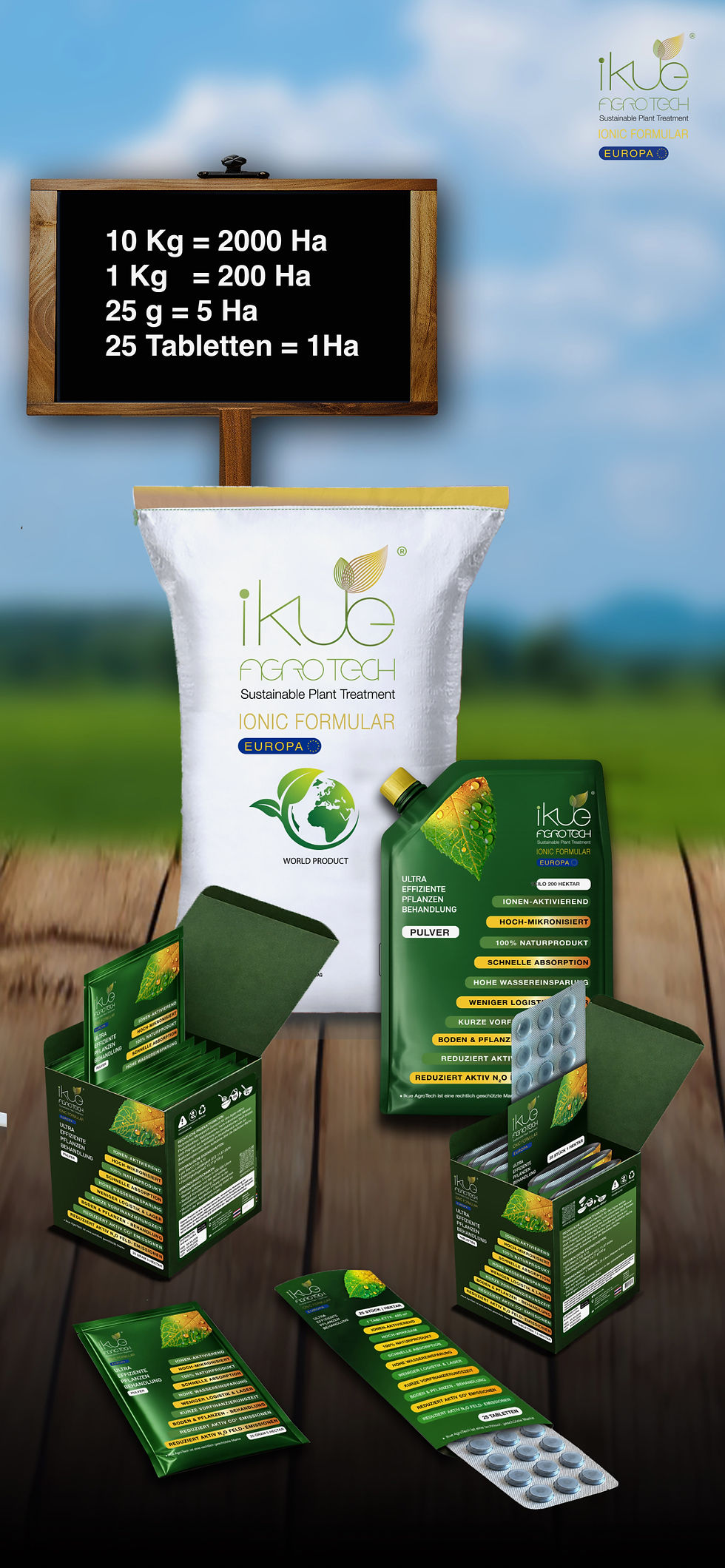
10 Kg
1 Kg
20 g
25 Stk.
=
=
=
=
2000 HECTARE
200 HECTARE
4 HECTARE
1 HECTARE
DEMAND

CONVENTIONAL
FERTILIZER
10.000Kg = 200 HECTARE


GIFTIG

IKUE
AGROTECH
1Kg = 200 HECTARE
NONE TOXIC
ADVANTAGES


Clear increase in green mass, taste, and yield.
Up to 100% higher yields. Observed under certain growing conditions.
Water consumption reduced by up to 70%
Purely natural - 100% mineral
Shortening of the growing season by up to 30%
Up to 50% lower costs compared to conventional fertilizer & Ikue AgroTech
Exceptional preventive effect against fungi, insects, and plant diseases through improved resistance
Up to 75% less conventional fertilizer. Depending on the plant and environmental conditions.
Extremely strong CO₂ reduction in the logistics sector and N₂O field emissions.
University studies and field results show that the use of conventional fertilizer can be reduced by up to 50% - 75% when used together with Ikue AgroTech. The degree of reduction depends on soil conditions, water availability, climate, the type of crop, and farming practices, and it can improve over time as soil conditions and nutrient efficiency develop.
CO₂ REDUCTION

Conventional fertilizer
AgroTech® Fertilizer
Transportvolume
2500kg
1kg
Consumtion-Hectare
Ca.. 50 kg/Hectare
Ca.. 20g/Hectare
Productivity:
Max. 50 Hectare
Max.50 Hectare
Departure
Thailand
Thailand
Arrival
South Africa
South Africa
Distance
10583km
10583km
CO2 Emissions
Ca.. 201,28kg
Ca.. 0,08kg
Approx. CO2 savings per month:
Approx. CO2 savings per month:
201Kg/ CO2 / Monthly
Approx. CO2 savings per year:
2.412.Kg /CO2 / Year


Max. 20g/
Hectare

50Kg/ Hectare
Conventional fertilizer


100% CO₂ neutral production.
90% less transport volume.
90% less CO₂ emissions.
50 - 75% less N₂O emissions.
The production of Ikue AgroTech® is 100% CO₂-neutral. Using drones to spread Ikue AgroTech® is another advantage to help reduce CO₂ emissions.
If you replace conventional fertilizer with Ikue AgroTech® , the amount that needs to be transported is reduced by up to 90%. This lowers CO₂ emissions in the logistics sector, from the production site to the consumer, by up to 60% depending on the type of transport.
N₂O REDUCTION


Ikue AgroTech® reduces N₂O
field emissions by up to 75%
WHY THIS IS IMPORTANT!!!
Nitrous oxide is a potent greenhouse gas, more than 270 times more harmful than CO₂.
If a farmer uses 100 kg of NPK fertilizer per hectare (with 20% nitrogen), approximately 0.3 kg of nitrous oxide (N₂O) is released. This is equivalent to roughly 86 kg of CO₂ emissions per hectare.
PESTIZIDS

Mechanical effect and the stronger growth keep insects away from the plants:
The silica particles look like tiny glass shards, they don’t change and stay on the leaf surface, and they have a very nice side effect:
The first effect of the silica:
All insects that have sensory organs in their legs find it unpleasant and will keep their distance from the plant because it’s uncomfortable. Here we have a deterrent through a physical process.
The second effect of the silica:
Sometimes the particles are so fine that they disturb and block the respiratory organs of unwanted insects, like mites and aphids. They don’t like the silica because it attacks their gills. We have many insects that perceive the leaf fertilizer as a deterrent.

TECHNOLOGY


Acceleration of the photosynthesis process
How does it work?
Ikue AgroTech® penetrates directly into the leaf pores (stomata – leaf organs that control gas exchange in the plant) and reaches the plant's interior. This is possible due to the fertilizer's granule size (0.1 μm), which is much smaller than the opening of a leaf pore (ostiole). After penetrating the intercellular space of the leaf through the pore (stoma), calcium carbonate (CaCO3) is split into calcium oxide (CaO) and carbon dioxide (CO2). The carbon dioxide is immediately incorporated into the process of photosynthesis. Using sunlight (which is converted into energy through chemical bonds), water, and carbon dioxide, organic compounds are produced. Since the intensity of photosynthesis depends primarily on light intensity and CO2 concentration, the fertilizer ensures an optimal amount of CO2 for the plant, thus contributing significantly to the photosynthesis process, as well as to primary and secondary metabolic processes and other physiological processes.
IONIC TECH


IKUE IONIC TECH:
Wie funtioniert es?
Stimulates ion channels:
The unique formula enhances the movement of ions through cell membranes, optimizing nutrient absorption.
Activates enzymes & hormones:
Ion stimulation activates important enzymes and natural growth hormones (auxins, cytokinins), speeding up growth and boosting resilience.
Increases stress resistance:
Plants treated with Ikue fertilizer show higher tolerance to drought, salinity, and diseases thanks to ion balance and cell wall strength.
Improves photosynthesis & root development:
By activating Mg²⁺ and PO₄³⁻, the fertilizer increases energy production and promotes deeper, healthier roots.

INGREDIENTS
What is fertilizer?
Ikue Agrotech fertilizer is classified as a 100% mineral fertilizer.
All nutrient components are derived from naturally occurring minerals.
The product is not chemically synthesized and contains no organic substances of plant or animal origin.
Therefore, it is not considered a chemical or organic fertilizer, but rather a natural, mineral-based solution suitable for sustainable and precise agriculture.
Ikue AgroTech® is 100% NATURAL, does not pollute or harm the environment, and is therefore suitable for organic farming and arable farming.
Ikue AgroTech's IONIC TECH
is an advanced fertilizer innovation that activates natural ionic processes in plants, improving growth, nutrient uptake, and overall plant health through precise biostimulation.
What is IONIC TECH?
IONIC TECH refers to the activation of positive (cations) and negative (anions) ions in the plant system.
These ions are essential for nutrient transport, metabolic regulation, and ensuring healthy development.


APPLICATION
This cycle starts with each application of Ikue AgroTech®. The more applications, the better the tree or plant.

1) Ikue AgroTech® is applied to the leaves of a plant in the morning.

2) In a short time, the photosynthesis of the leaves with sunlight has increased significantly due to the fertilizer. The leaves are producing more glucose and starch.

3) By producing sugar and starch in its leaves, the plant or tree boosts water and nutrient uptake from the soil to use the extra sugar and starch.

4). The plant or tree uses more water than the roots can supply. So it grows more roots. More roots can absorb more water and take in more nutrients (N, P, K). The plants become healthier and stronger.

5). The additional roots are now transporting more nutrients. This is beneficial for both the flowers and the fruits.
The plant or tree should not produce any flowers or flower clusters. The result: more yield, higher fruit quality (BRIX), and a healthy plant or tree.
Case study
Ikue AgroTech® has been used for years in many countries and on various plants with impressive results.
When you open the studies, you'll find a selection of success stories where the use of fertilizers led to higher yields or recovery from diseases and pests.


Engagement
Your commitment to healthy, sustainable farming.
Become part of our humanitarian projects.

FAQ
You can find some answers to your questions in our FAQs

Solitions & Downloads


AgroTech®
CO2 Savings /Monthly
201 Kg/ CO2 / Monthly
Conventional fertilizer
Ikue Agro Tech
20ft container
Max. 10 Tons
approx. 8 Kg/Hectare
Max. 1.250 Hectare
Production in Austria
South Africa
13.388 Km
approx, 640 Kg
1.490 Kg/ CO2 / Month
17.720 Kg /CO2 / Year
20ft container
Max. 10 Tons
approx. 50 Kg/Hectare
Max. 200 Hectare
Production in Austria
South Africa
13.388 Km
approx, 2.130 Kg
Transport:
Fertilizer quantity/ 20ft:
Consumption/hectare:
Productivity:
Departure:
Arrival:
Distance:
CO2 emissions:
CO2 savings per month:
CO2 savings per year:
AgroTech®
CO2 Savings / Annually
2412 Kg /CO2 / Annually


Mechanical effect keeps insects away from leaves:
The silicate particles look like tiny shards of glass and they don’t change, staying right on the surface of the leaf.
They also come with a nice little bonus:
The first effect of the silicate:
All insects that have touch sensors on their legs find this unpleasant and will stay away from the plant because it feels uncomfortable.
So here, we have a repellent that works through a physical process.
The second effect of the silicate:
Sometimes the particles are so fine that they interfere with and block the breathing organs of unwanted insects, like mites and aphids.
They don’t like the silicate because it attacks their gills.
Basically, there are a lot of insects that find this leaf fertilizer to be a repellent.

